A cinematic paleontology docuseries in development, built primarily with generative AI.
Evolution of Us traces the full arc of life on Earth, from the first cells to the species now building AI, built shot by shot with generative AI by director Harrison Smith.
Evolution of Us is a cinematic paleontology docuseries in development that traces the four-billion-year arc of life on Earth, from the first single-celled organisms to modern humans, the species that now builds AI. Director Harrison Smith and a small team are visualizing deep time using the consumer-tier generative AI tools of 2026, creating what is, to their knowledge, one of the first cinematic-quality paleo projects made this way. A series about wonder, deep time, and the improbable fact of us.
Evolution of Us is a cinematic paleontology and evolution docuseries in development, tracing the full arc of life on Earth, from the first single-celled organisms in primordial seas, through the explosion of complex life, the age of dinosaurs and the rise of mammals, to the emergence of consciousness, language, and the species that now builds artificial intelligence.
Directed by independent filmmaker Harrison Smith with a small team, the series is being visualized shot by shot using the generative AI tools of 2026, including Seedance 2, Kling 3, Gemini Omni (Veo), Midjourney, GPT Image 2, and Nano Banana Pro, alongside a custom AI morphing pipeline for evolution sequences. To the director's knowledge, it is one of the first cinematic-quality paleontology projects built primarily with generative AI. The trailer was reviewed prior to release by a paleoanthropologist at a major research university.
The series is not a technology demonstration. It is a meditation on deep time, beauty, and the improbability of existence, an attempt to render the long story of life with the cinematic weight typically reserved for productions with nine-figure budgets and forty-artist VFX teams.
The trailer premieres Tuesday, June 2, 2026. The pilot episode arrives in the coming months, with the full series to follow.
Evolution of Us is built entirely on consumer-tier generative AI tools, with no studio, no custom model training, and no enterprise pipeline.
I made Evolution of Us because I wanted to see it.
The story of life, the actual story, four billion years of it, is the most beautiful thing I know about. From the first spark of self-organization in some warm ocean, through the unimaginable patience of single-celled life, to the explosions of complexity that gave us trilobites and dinosaurs and birds and us, it is, to me, the closest thing to a sacred text. And we walk around mostly forgetting it.
For most of cinema's history, telling this story at scale required a team of fifty artists and a studio's budget. The tools that emerged in 2025 and 2026 changed that. With Seedance, Kling, Gemini, Midjourney, a small team, a few patient advisors, and a stubbornness verging on obsession, we can now render deep time at a quality that used to belong to BBC Earth and Apple TV. Not in every shot, not perfectly. But enough that I had to try.
The series is a meditation on the fact that we are here at all. Statistically, none of us should be. The cell that became you crossed an unbroken line back to the first cell. So did the cell that became the moss outside your window. We are cousins of everything that lives. That is the deepest truth science has uncovered, and I don't think we let ourselves feel it often enough.
If this series helps even a few people feel more connected, to the past, to each other, to the strange luck of being conscious in a universe that is mostly silent, the work was worth it.
— Harrison Smith, Director
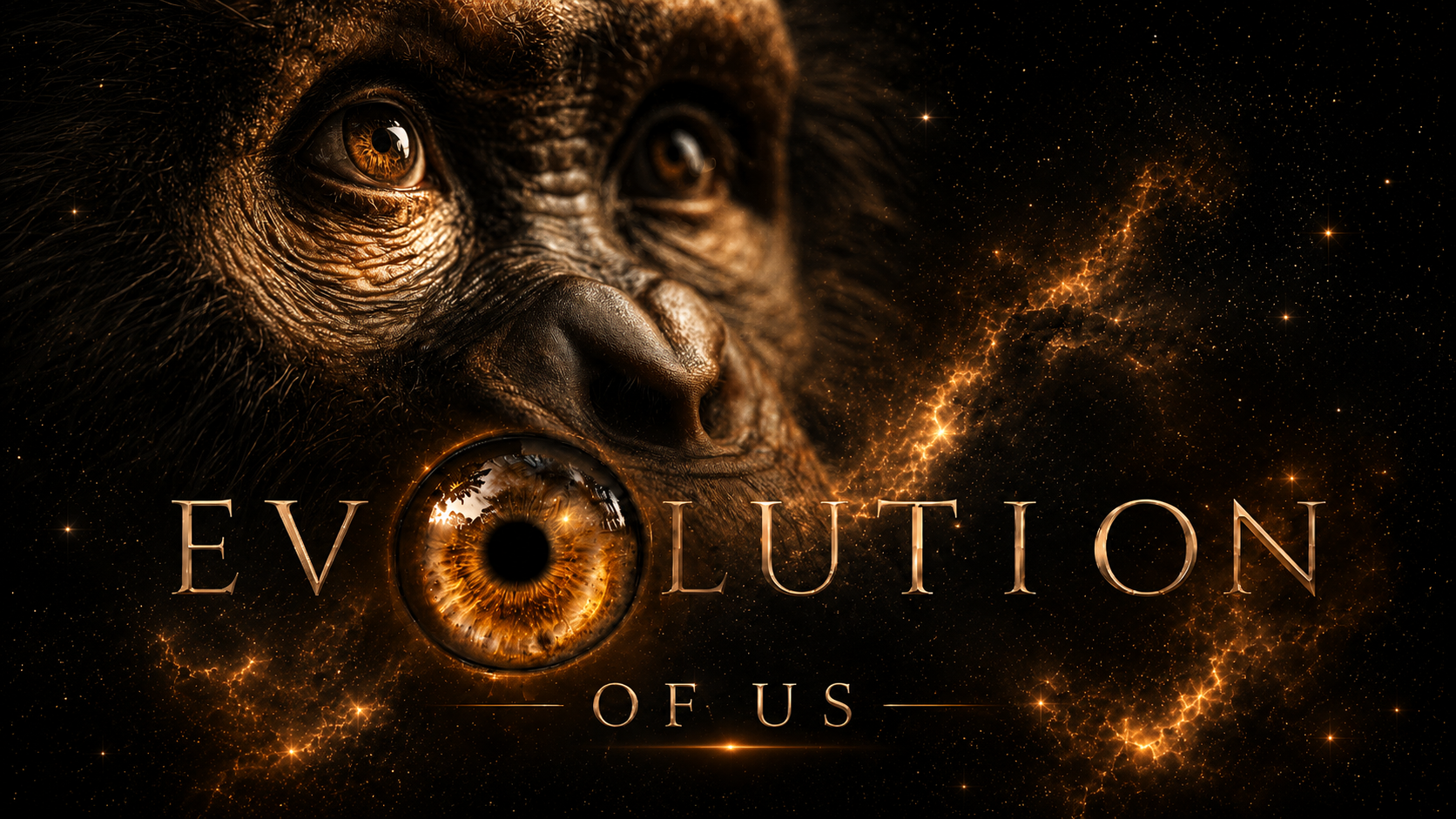
Evolution of Us is built primarily using generative AI tools released in 2025 and 2026: Seedance 2 for cinematic motion, Kling 3 for creature animation, Gemini Omni (Veo) for environments, Midjourney, GPT Image 2, and Nano Banana Pro for stills, and a custom AI morphing pipeline for evolution sequences. The director did not train any of these models and uses them on the same publicly available terms offered to any consumer.
The question of how these models were trained, and what that means for the artists whose work informed them, is unresolved, and the production does not claim a settled position on it. What can be said:
Paleontologists who spot errors, and artists who recognize their style in any frame and want to discuss, are invited to reach out. Both kinds of correction will inform future episodes.
The trailer was reviewed prior to release by a paleoanthropologist at a major research university, who found no significant errors. As the full series develops, the human-evolution material will undergo further review. The production welcomes scientific feedback and treats accuracy as an ongoing process rather than a finished claim.
Harrison Smith is an independent filmmaker and technical artist. He spent years working in technical art and AI-assisted CGI on AAA games at Electronic Arts (EA) and on personal projects before turning that craft toward independent filmmaking.
He runs CuriAWEsity, a YouTube channel focused on science, nature, and the future, and a Facebook page of AI-driven evolution-morphing videos with roughly 24,000 followers. Evolution of Us is his most ambitious project to date, an attempt to bring the cinematic weight of major natural-history productions to an independent, AI-built workflow.
You are the most incredible walking, living collection of nanofactories. How did they rearrange themselves to make you, you?
The impossibility of life through evolution is the closest thing that scientifically minded people can get to God.
I made Evolution of Us because I wanted to see it.
For most of cinema's history, telling this story required fifty artists and a studio's budget. The tools that emerged in 2025 and 2026 changed that.
No. Evolution of Us is authored work: directed, edited, color-graded, and assembled shot by shot by a filmmaker with a technical-art background, in service of a specific story. Generative tools are the brush, not the artist. The intention, the structure, the scientific grounding, and the creative choices are human.
The trailer was reviewed by a paleoanthropologist at a major research university and found to have no significant errors. The series draws on current paleontology literature. Like Walking with Dinosaurs and Prehistoric Planet, it takes some creative liberties for visual storytelling. Accuracy is treated as an ongoing process, and corrections are welcomed.
2026's consumer-tier generative AI tools, combined with years of technical-art experience, now let a very small team produce cinematic imagery that previously required large VFX studios. Evolution of Us is, in part, a test of how far that goes.
The trailer premieres Tuesday, June 2, 2026. The pilot episode arrives in the coming months, with the full series to follow. Get notified at watchevolutionofus.com.
It is an independent production. No studio, no enterprise tooling.
To request additional assets, contact below.